
Milestones in Our History
-
1915
William Woods buys land that eventually becomes Seven Mountains Scout Camp.
In October 1915, William P. Woods buys the tract that is now Seven Mountains. Woods was the Scoutmaster of Troop 4 of Lewistown and had been a Scoutmaster since Scouting began in America in 1910. He builds the cabin the boys call the “White House,” known today as Flat Top, completed by 1916 and still one of the oldest continuously used Scouting buildings in the nation. At the time, the stream had only a small dam and was more of a mud hole than a swimming area, which made the council hesitant to make the site a permanent camp. Mr. Woods kept bringing his troop to enjoy the property anyway, and he took them to other long-term camping locations too, including the Treaster Valley Camp.
-
1929
Council Formed
The Juniata Valley Council is formed, covering Juniata, Mifflin and Huntingdon Counties, with Centre County added in the early 1930s. Ralph D. Noe is the first of the council presidents and Kenyon Woody serves as Scout Executive through the 1930s.
-
1933
Trial Run at Seven Mountains
In the summer of 1933, William P. Woods, then chairman of the council’s Camping Committee, gives the combined council use of his land for its annual camp, “Aquanuschioni.” Leaders from across the council tell Scout Executive Kenyon Woody they approve of the site. After the successful season, Mr. Woods arranges for the Civil Works Administration to develop camp facilities. According to a construction log, work on the dam begins in December 1933, with buildings started at the same time. Crews of 20 to 50 men work through the cold winter, hauling chestnut logs from Greens Valley and focusing on the dam and a ball field in what is now the Commissioners Area. Lumber from the trees cleared for the dam is used to make a shower facility.
-
1934
First Camping Season
After the winter of CWA construction, Seven Mountains opens for its first official camping season. The camp fee that first summer is $3.00. A small staff, a cook, camp director, health lodge director, aquatics staff and program aides, runs the program, while counselors act as Scoutmasters in each of the three original campsites: Kit Carson, Pioneer and Indian. Scouts are assigned to a site rather than camping with their home troop. By deed dated October 16, 1934, Mr. Woods donates the original tract, called Parcel A, to the council, keeping the rest for Troop 4’s use. All of the original log cabin buildings still stand fifty years later.
-
1934
Juniata Valley Council Chartered
The Juniata Valley Council, BSA is chartered to serve Scouting in Blair, Centre, Huntingdon, Juniata and Mifflin Counties. Seven Mountains becomes the council’s outdoor laboratory for Scouting, a role it has held ever since.
-
1935
Seven Mountains becomes Camp Aquanushioni
The Scouts and Scouters of the council decide that the name Seven Mountains Boy Scout Camp is not romantic and lacks tradition, so the camping committee announces that the camp will be renamed at the first campfire of the 1935 season. On June 29, 1935, it becomes “Camp Aquanuschioni,” meaning “United People” or “Meeting of the Tribes,” after the federation of central Pennsylvania tribes that included the Shawnees, Munseys, Mingoes and Tuscaroras, and the name the council had already used for its earlier camps. The same year, because the lake was declared unsafe for swimming without chlorine during the polio epidemics, a crew of 20 men lives in camp for six weeks to clear the trees at the upper end of the lake and enclose a 50-by-100-foot area with a baffle wall, so that part of the lake can be chlorinated without harming the fish. The wall has a three-foot-wide runway on top, and the leftover planks go into the shower house below the dam.
-
1936
Monaken Lodge Founded
The Order of the Arrow’s Monaken Lodge begins at Seven Mountains, with Jack Swetic as Lodge Chief in 1936 and 1937, the first names on the lodge’s list of chiefs. The lodge has been in continuous existence ever since, and its service projects have done much to keep camp in shape, from the campfire circle seats to Rimmey Lodge to a porch awning built at the 1983 Fall Ordeal. Little is known about how the early lodge got started, and the 1984 history asks anyone with information about the Order of the Arrow in the 1930s and 40s to contact the lodge through the council office.
-
1944
Mr. Woods Deeds the Rest of the Land
On August 8, 1944, Mr. Woods deeds the remainder of his land, Parcel B, to the council, which had been held back for Troop 4’s use. The lower campsite area comes into use as camp expands between 1947 and 1953: Moyer, named for Ben P. Moyer of State College, Scoutmaster of Troop 31; Elks, built by the Lewistown Elks; Wallace, for the Assistant Scoutmaster of Troop 380 in Boalsburg; and Rhoads, for Bob Rhoads of Centre Hall, an early leader of Monaken Lodge and the camp. Later, the council swaps part of the eastern section of camp with the Commonwealth of Pennsylvania for the area marked Parcel C, a deal recorded in a 1963 deed, and a survey of the camp boundary leads to a blazed trail for a hiking award for Scouts who hike the 2.5-mile border of camp.
-
1949
Capital Campaign Builds the Camp
A camp development program, started in 1947 when Council President Randal Leopold names John R. Wald as chairman, pays for a burst of building in 1949. Wood, Wald and Pioneer Cabins are built from the same plans at $3,000 each, the John R. Wald Memorial Dining Hall costs $9,000, and $2,000 goes to a winterized 6,000-foot water system and the grading and clearing of the present Activities Field and archery range, about $20,000 in all. The State College Lions Club donates the shower house beside the new dining hall. Until then, meals had been served for about fifteen years in the building that is now the Trading Post, with eight Scouts at a table and two waiters.
-
1954
John R. Wald Dining Hall Dedicated
The council dedicates the Dining Hall in 1954 to the memory of John Royal Wald (1888–1952) of Huntingdon. A charter member of the council, a commissioner, council president, chairman of the Camp Development Committee, member of the Order of the Arrow and Silver Beaver recipient, he worked for years to develop camp and died in 1952. A plaque in the dining hall recognizes his loyalty to Scouting’s program of character building and good citizenship. That same year the council’s districts are merged into the three districts named in the 1984 history: Nittany, Shawnee (from Muncey and Juniata) and Oneida (from Kishacoquillas, Standing Stone and Captain Jack).
-
1958
Leopold Handicraft Lodge
The Lewistown Rotary Club builds the Leopold Handicraft Lodge, named for Randal Leopold, a former council president who also lent his name to the Scout Service Center in Lewistown. Originally open-sided and designed for crafts, it is later closed in and now serves as a winter cabin like the Wood, Wald and Pioneer cabins, with an extension added in the summer of 1982 so it can sleep more boys. It replaces the old open-sided pole building across from the Health Lodge, which had been a handicraft lodge, then a nature lodge, and was torn down in the early 1960s. It was the last new building at camp until 1980.
-
1970
First Wood Badge at Seven Mountains
Seven Mountains hosts its first Wood Badge course for Boy Scout leaders, June 13–21, 1970, with Robert C. Moore as course director and a staff of Juniata Valley Council leaders. Wood Badge is a leadership development program: a 7- or 8-day outdoor experience of living Scouting, followed by an application period of at least six months in which each participant works with a counselor. Participants are organized in patrols, and the 1970 course members make up the Working Beaver, Winged Bob White, Screeching Eagle and Ready Foxes patrols. Later courses follow here on August 20–26, 1977 and August 9–16, 1980, drawing Scouters from the Juniata Valley, Susquehanna, Bucktail, Keystone, Westmoreland-Fayette and Lancaster-Lebanon councils, and a fourth is planned for the end of summer 1984.
-
1972
First Klondike Derby Held
Seven Mountains Scout Camp hosted the inaugural Klondike Derby. This winter tradition would go on to become an annual event, challenging generations of Scouts with cold-weather sled races, teamwork, and outdoor skills testing at “town” stations.
-
1984
Fifty Years of Molding Boys into Men
Seven Mountains marks its 50th anniversary with a commemorative logo and a book. Rob Wilson, who worked six summers on camp staff, compiles Highlights of Seven Mountains Boy Scout Camp, 1934–1984 from historical records, noting that facts get lost and stories grow over the years, and that more information turned up in six months than in the previous six years. The book records the camp’s early years, buildings and memorials, council presidents, district leaders, camp directors, camp rangers, Monaken Lodge chiefs and Wood Badge rosters, with thanks to Dorn Van Dommelen for the maps and Robert Dapp of State College for restoring the photographs. At the time, Sam Halderman was the only person still working with camp who had been active when it first opened.
-
2004
A Modern Era of Donor Support
Beginning in 2004, gifts from donors and Friends of Scouting fund more than $1 million in improvements to camp facilities and programs, including pavilions, waterfront upgrades, and building renovations.
-
2008
25th Anniversary of Rimmey Lodge
Monaken Lodge celebrated the 25th anniversary of Rimmey Lodge with a rededication of the cabin.
-
2009
Celebrating 75 Years
Seven Mountains marked its 75th year with a massive council-wide event from May 1–3, uniting all Scouting programs, alumni, and the local community. Highlights of the celebration included council-wide reunions and the unearthing of the camp’s 50th-anniversary time capsule.
-
2013
Monaken Lodge Celebrates 75 Years
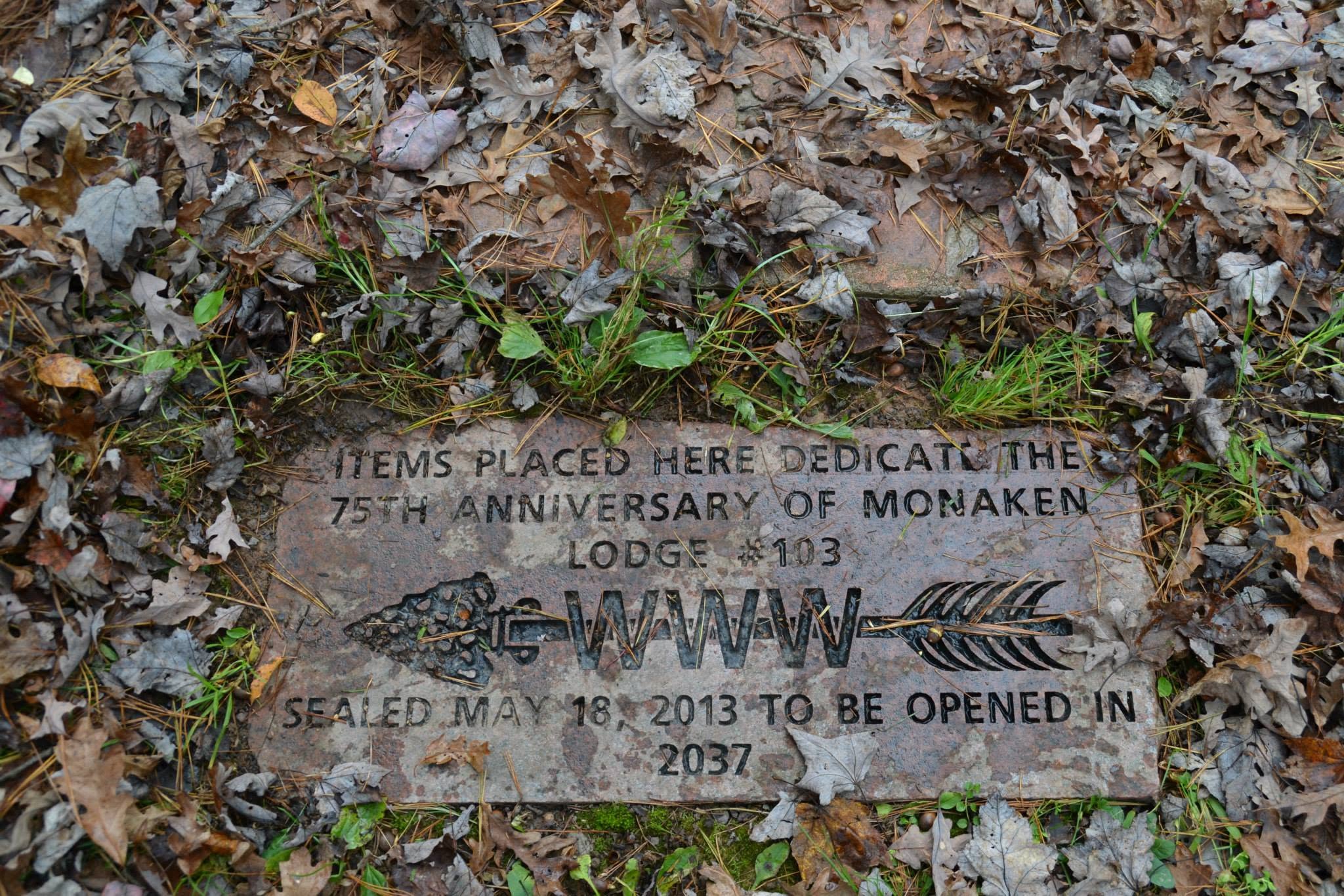
Monaken Lodge celebrated its 75th anniversary, marking the historic milestone by burying a new time capsule for future generations.
-
2015
Section NE-4B Conclave & OA Centennial

Monaken Lodge 103 hosted the Section NE-4B Conclave. Coinciding with the 100th Anniversary of the Order of the Arrow, the weekend brought hundreds of Arrowmen together for centennial celebrations, specialized training, and inter-lodge competitions.
-
2020
John M. Kriner II Lodge
After ten years of planning, the lodge overlooking the lake is readied for opening. Made possible by a lead gift from John and Betta Kriner and named for their son, an Eagle Scout and Silver Beaver recipient, it sleeps 40, is fully accessible, and is supported by an endowment for its upkeep. More than 100 other donors help build it.
-
2026
Camp Today
More than 200 acres of cabins, pavilions, a lake, a dining hall seating 300, the Don Bailey Campfire Circle, and an outdoor chapel welcome Cub Scouts and Scouts BSA, boys and girls, for summer camp and visitors year-round.
-
2027
Alumni Reunion at Camp
Alumni are invited back to Seven Mountains in April 2027 for a reunion. Join the email list to be the first to hear when details and registration open.